The AquaINFRA Project
The AquaINFRA project (2023–2026) is developing a next-generation virtual environment equipped with FAIR (Findable, Accessible, Interoperable, and Reusable) multidisciplinary data and services.
Our mission is to help marine and freshwater scientists and stakeholders restore healthy oceans, seas, and inland waters by bridging the gap between isolated research infrastructures and national borders.
[!IMPORTANT] Main Resource: For the most up-to-date project news and developments, visit the AquaINFRA Homepage.
📽️ Video Tutorial: Getting Started
Learn how to search for data on the AquaINFRA Interaction Platform (AIP), subset it via the Data Discovery and Access Service (DDAS), and import it directly into your analysis history in Galaxy.
Core Objectives:
- Marine-Freshwater Integration: Breaking down barriers to support collaboration across the entire land-sea continuum.
- EOSC-Based Infrastructure: Establishing a cross-country discovery mechanism powered by the European Open Science Cloud (EOSC).
- Spatio-temporal Analysis: Offering standardized services to model biological, chemical, and physical data.
- Reproducible Science: Ensuring analytical workflows can be openly shared, reused, and validated.
Project Methodology: Official Architecture
The AquaINFRA ecosystem connects disparate data sources into a unified analytical pipeline. This ensures smooth integration with both the Digital Twin of the Ocean (DTO) and EOSC components.
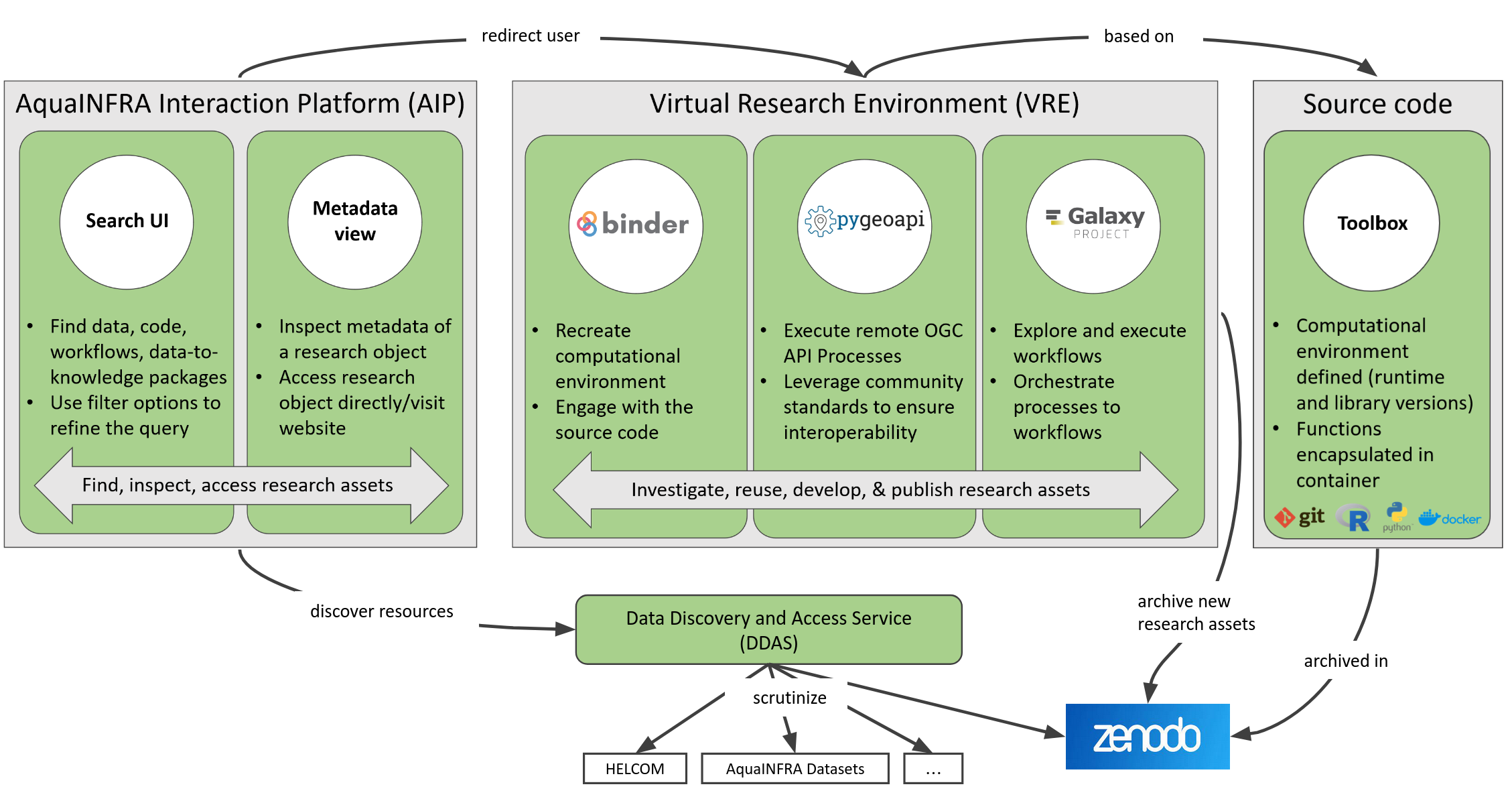
[!NOTE] AquaINFRA works closely with projects like Blue-Cloud, ILIAD, and EDITO to supply the Digital Twins of the Ocean with high-quality aquatic data and models.
Partners & Target
The AquaINFRA project is a joint effort of 21 international partners across Europe, including universities, SMEs, and research institutions.
Who is it for?
Marine and freshwater scientists or data analysts looking to build reproducible workflows using FAIR data services.
Why use it?
To access diverse aquatic data, high-performance computing, and standard analytical pipelines all within one virtual space.
What is provided?
Pre-configured tools like Galaxy and Jupyter, harmonized data collections, and guided training modules for real-world scenarios.
How to contribute?
Researchers can share their own notebooks, tools, and datasets via AquaINFRA to foster community collaboration.
Our Consortium
Coordinated by Aalborg University (AAU) (Denmark), our partnership unites top experts in aquatic science and data technology.
Representative Partners:
- Scientific Institutions: BOKU (Austria), CSIC (Spain), CREAF (Spain), SYKE (Finland), NIVA (Norway), HEREON (Germany).
- Infrastructures & Organizations: HELCOM (Baltic Sea), CSC (Finland), Maanmittauslaitos (Finland).
- Technical Specialists: 52°North (Germany), Blue Lobster IT (UK).
View the full partner list on the official site
The AquaINFRA Virtual Research Environment
The AquaINFRA Virtual Research Environment (VRE) is a modular, open-source platform. It acts as the analytical engine of the project, allowing researchers to run complex operations via an intuitive interface.
Key Technologies
- Galaxy Platform: A powerful web-based gateway for accessible and reproducible spatial analysis.
- Aqua Interaction Platform (AIP): A tool to seamlessly search Earth observations and European hydrography.
- Binder & OGC API: Services providing interactive computing and standardized data processing.
- Language Support: Native environments for R and Python.
Why use the VRE?
- FAIR Processing: Workflows developed in our case studies are published as D2KP with full provenance.
- Cross-Domain Discovery: Discover digital resources across different scientific disciplines and borders.
- High-Performance Computing: Use robust cloud resources for large spatio-temporal modeling without managing local hardware.
[!TIP] Visit the AquaINFRA VRE Portal to explore community-tailored tools and launch your first analysis.